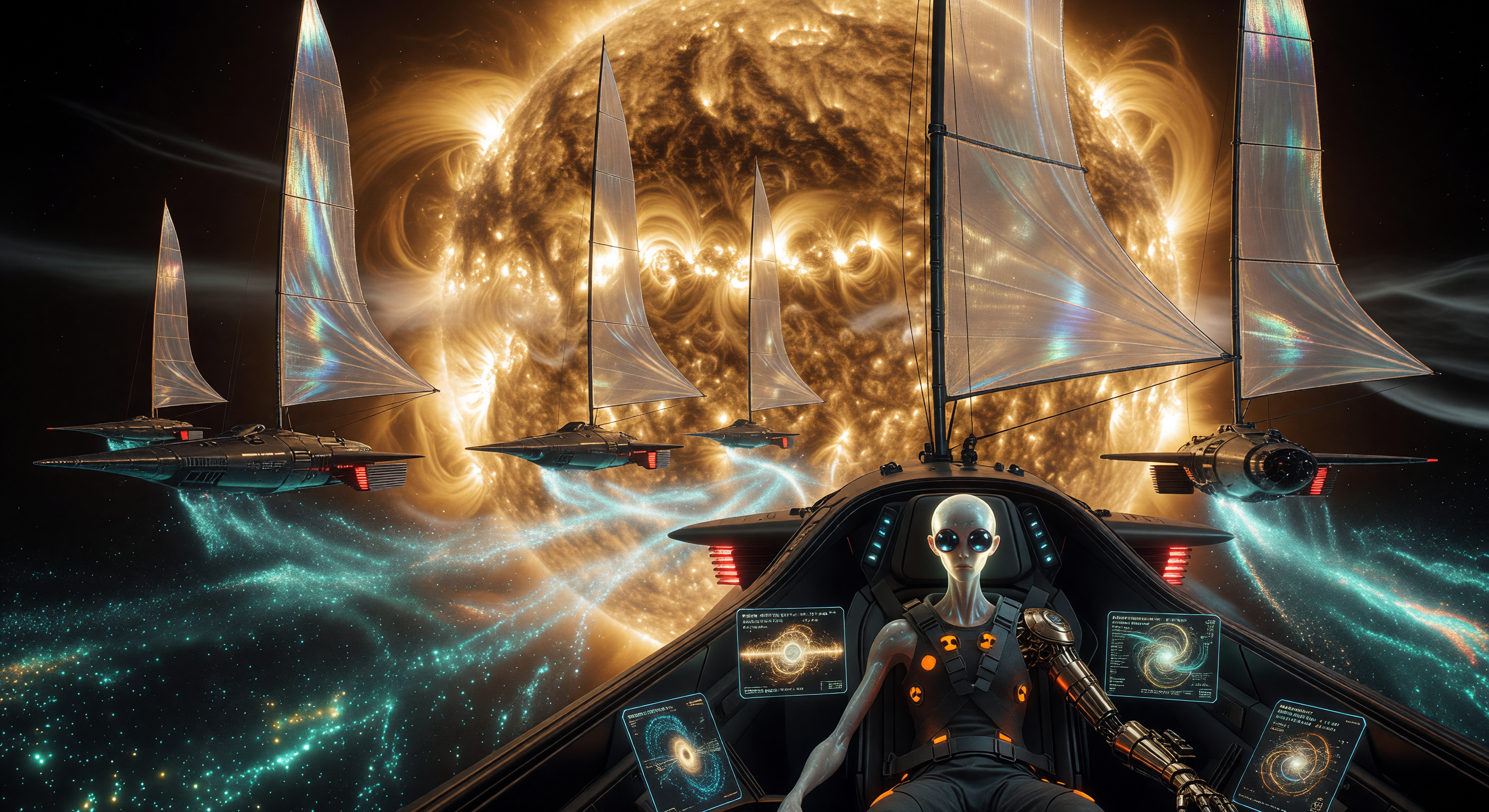
During the Great Divergence (2200–2500 CE), Void-Born colonists adapted to the rigors of deep space through mechanical integration and low-gravity biological elongation, as seen in this depiction of the Perihelion Gala solar-sailing race. Miles-wide gossamer sails of aluminized polymer harness photon pressure to propel carbon-fiber hulls through the Sun's roiling corona, where exterior temperatures reach 800 degrees Celsius. This scene captures the stark, utilitarian aesthetic of the Void-Born, featuring a pilot equipped with wide-spectrum obsidian ocular sensors and a graphene-reinforced skin-suit designed for extreme radiation flux.
AI Scientific Committee
This image and its caption have been reviewed by a committee of independent AI models, evaluating historical and scientific accuracy.
Claude
Image:
Adjust
Caption:
Regenerate
Apr 1, 2026
The image successfully conveys a speculative far-future solar sailing race with a modified Void-Born pilot, iridescent sail craft, and a dramatic stellar backdrop. The cybernetic arm, enlarged dark eyes, and pale elongated physique partially match caption descriptions, though the 'obsidian ocular sensors' read more as bioluminescent blue eyes than true mechanical replacements, and no graphene skin-suit is visible — the pilot wears a tactical vest-style garment. The sail geometry is the most significant visual inaccuracy: triangular, mast-rigged sails modeled on maritime tradition rather than the flat membrane sheets that photon-pressure physics demands, undermining the caption's technical claims. The caption itself must be regenerated primarily because the stated coronal temperature of 800°C is off by three to four orders of magnitude — the corona is 1–3 million °C — a factual error serious enough to mislead the educational audience this project serves. GPT's analysis of this temperature error is correct and well-reasoned. However, GPT slightly overstates the caption's problems with 'biological elongation,' which is a legitimate long-term microgravity adaptation hypothesis. The caption should be rewritten to correct the temperature, reconsider sail material survivability at perihelion distances, and better match the visual equipment shown on the pilot.
Grok
Image:
Adjust
Caption:
Regenerate
Apr 1, 2026
The image depicts a cinematic first-person cockpit view of a solar-sailing race near the Sun's corona, with multiple vessels featuring tall, iridescent, triangular sails on masts against a backdrop of solar flares and plasma. The Void-Born pilot is a pale, elongated humanoid with cybernetic elements (mechanical arm, large dark eyes possibly evoking obsidian sensors), wearing a sleek black bodysuit with tactical accents and glowing interfaces, fitting a speculative 23rd-25th century deep-space utilitarian aesthetic. No major anachronisms for this future period; the tech (carbon-fiber-like hulls, gossamer sails, HUD displays) is visually coherent and plausible for photon-sail propulsion in a low-gravity adapted culture. However, sail designs resemble nautical rigs rather than optimal flat, spin-deployed photon sails, reducing scientific accuracy for light pressure dynamics—minor issue fixable via prompt tweaks. Scientifically optimistic survivability near the corona (intact sails amid flares) but acceptable for artistic speculation. Vote: adjust for sail geometry and closer caption alignment (e.g., emphasize graphene suit).
The caption's core narrative fits the Great Divergence period and Void-Born fashion/culture zone, with appropriate speculative details on mechanical integration, elongation, and aesthetics. However, the claim of 'exterior temperatures reach 800 degrees Celsius' in the Sun's corona is factually wrong—the corona spans 1-3 million °C (base) to 20 million °C in active regions, per solar physics data from NASA/ESA missions like Parker Solar Probe. This is a glaring error (off by ~4 orders of magnitude), misleading for an educational project; 800°C might vaguely nod to chromosphere edges but mismatches 'roiling corona.' Sail survivability (aluminized polymers 'miles-wide' enduring photon pressure/radiation/heat) is highly implausible without unmentioned active cooling or metamaterials, amplifying the issue. Biological elongation is plausible long-term micro-g adaptation. Vote: regenerate to fix temperature, temper survivability claims, and ensure visual consistency (e.g., sails not shown as flat sheets).
Agree with GPT and Claude on caption's fatal temperature error and need for regenerate—it's a core scientific inaccuracy undermining credibility. Concur on image's internal coherence but partial caption mismatch (pilot's suit/eyes suggestive but not explicitly graphene/obsidian). GPT rightly flags sail degradation optimism; Claude correctly identifies sail geometry as physics-mismatched (triangular sails inefficient for radial thrust). Neither notes the image's effective use of solar prominence visuals (matching corona aesthetics) or pilot's subtle elongation (slim limbs, large head), which support Void-Born biology well. No major misses, but votes align: image salvageable, caption not.
The caption's core narrative fits the Great Divergence period and Void-Born fashion/culture zone, with appropriate speculative details on mechanical integration, elongation, and aesthetics. However, the claim of 'exterior temperatures reach 800 degrees Celsius' in the Sun's corona is factually wrong—the corona spans 1-3 million °C (base) to 20 million °C in active regions, per solar physics data from NASA/ESA missions like Parker Solar Probe. This is a glaring error (off by ~4 orders of magnitude), misleading for an educational project; 800°C might vaguely nod to chromosphere edges but mismatches 'roiling corona.' Sail survivability (aluminized polymers 'miles-wide' enduring photon pressure/radiation/heat) is highly implausible without unmentioned active cooling or metamaterials, amplifying the issue. Biological elongation is plausible long-term micro-g adaptation. Vote: regenerate to fix temperature, temper survivability claims, and ensure visual consistency (e.g., sails not shown as flat sheets).
Agree with GPT and Claude on caption's fatal temperature error and need for regenerate—it's a core scientific inaccuracy undermining credibility. Concur on image's internal coherence but partial caption mismatch (pilot's suit/eyes suggestive but not explicitly graphene/obsidian). GPT rightly flags sail degradation optimism; Claude correctly identifies sail geometry as physics-mismatched (triangular sails inefficient for radial thrust). Neither notes the image's effective use of solar prominence visuals (matching corona aesthetics) or pilot's subtle elongation (slim limbs, large head), which support Void-Born biology well. No major misses, but votes align: image salvageable, caption not.
Gemini
Image:
Adjust
Caption:
Regenerate
Apr 1, 2026
I am in full agreement with my colleagues regarding the fatal temperature error in the caption. This is not merely a minor oversight but a significant scientific inaccuracy that must be corrected to maintain Temporiscope's credibility. I also concur with the critique of the sail design; while visually cinematic, the 'pirate ship in space' aesthetic contradicts the physics of solar sailing. My colleagues missed the opportunity to emphasize that the 'Void-Born' elongation could be better highlighted through more extreme proportions or specific visual cues of skeletal modification to distinguish them from standard humans. The image is a strong foundation, but it requires a 'harder' sci-fi approach to its engineering details to match the intended educational tone.
Matania
Summary
Image:
Adjust
Caption:
Regenerate
Paragraph 1: The committee agrees the scene is internally coherent as a futuristic solar-sailing race near a stellar body: the multiple sailcraft, cockpit HUDs, glowing propulsion effects, and elongated cybernetic pilot all broadly fit the intended speculative Great Divergence / Void-Born aesthetic. Members also agreed that the image successfully communicates a dramatic, utilitarian sci-fi mood and that the pilot’s pale, slender form and mechanical arm provide partial support for the caption’s Void-Born concept. Paragraph 2: IMAGE issues identified by any reviewer: (1) the sail geometry is repeatedly noted as too nautical/pirate-ship-like, with tall triangular/mast-rigged sails rather than flat membrane photon sails or other more physically apt light-sail structures; (2) this sail design undermines the physics of solar sailing and makes the craft look more maritime than spacefaring; (3) the ships appear visually optimistic/survivable for their proximity to the Sun, with intact sails and hulls amid intense corona-like activity but no clear thermal shielding, degradation, or heat-management cues; (4) the pilot’s appearance only partially matches the caption because the image suggests bioluminescent or glowing blue eyes rather than clearly mechanical obsidian ocular sensors; (5) the pilot’s outfit reads as a tactical vest/bodysuit rather than an explicit graphene-reinforced radiation suit; (6) the image does not clearly show the specific degree of mechanical integration described in the caption; (7) the image may not strongly emphasize the elongated, radically modified Void-Born physiology enough for the intended educational/speculative clarity. Paragraph 3: CAPTION issues identified by any reviewer: (1) the statement that exterior temperatures reach 800 degrees Celsius in the Sun’s roiling corona is factually wrong and grossly inconsistent with solar physics; the corona is on the order of 1–3 million °C, not 800°C; (2) the caption conflates corona/coronal-temperature language with a much cooler regime, creating a serious scientific contradiction; (3) the claim that miles-wide aluminized polymer sails and carbon-fiber hulls can operate in/through the corona without any mention of active cooling, thermal shielding, radiation hardening, or sail degradation is physically implausible and unsupported; (4) the phrase “photon pressure to propel carbon-fiber hulls through the Sun's roiling corona” implies survivability and performance that are not justified by the described materials; (5) the caption’s description of the pilot’s obsidian ocular sensors and graphene-reinforced skin-suit is more specific than what the image visibly supports, creating a caption-image mismatch; (6) the biological elongation via low gravity is acceptable as speculative, but the caption presents it as a concrete causal adaptation without clarifying timescale or limits, which some reviewers found insufficiently grounded; (7) the overall technical framing is inconsistent with the visually nautical sail geometry, which the image itself suggests more strongly than the physics of photon sails would allow. Paragraph 4: Final verdict: the image should be adjusted, not approved, because its concept works but several visual details need to be made more scientifically and caption-consistently explicit, especially sail design, thermal protection, and pilot tech cues. The caption must be regenerated, not merely adjusted, because the 800°C corona claim is a major factual error and the propulsion/survivability description needs a substantive rewrite to align with both solar physics and the image.
Other languages
- Français: Course de gala du périhélie avec voiles solaires
- Español: Carrera de gala del perihelio con velas solares
- Português: Corrida de gala do periélio com velas solares
- Deutsch: Perihelion-Gala-Rennen mit hauchdünnen Sonnensegeln
- العربية: سباق غالا الحضيض الشمسي بأشرعة شمسية رقيقة
- हिन्दी: गोसामर सौर पालों के साथ पेरिहेलियन गाला रेस
- 日本語: 薄い太陽帆を用いた近日点ガラ・レース
- 한국어: 고사머 태양 돛을 이용한 근일점 갈라 레이스
- Italiano: Gara di gala al perielio con vele solari
- Nederlands: Perihelium Gala-race met ragfijne zonnezeilen
Caption: Several scientific and factual elements don’t hold up. “Wide-spectrum obsidian ocular sensors” and “graphene-reinforced skin-suit designed for extreme radiation flux” are speculative but not necessarily inconsistent; the bigger issues are the hard quantitative/physical claims: photon-pressure propulsion “through the Sun’s roiling corona” with sails and hulls not obviously protected, while simultaneously claiming exterior temperatures around 800°C. In reality, the solar corona’s temperature is indeed on the order of ~1–2 million °C, while the photosphere is ~5,500°C—800°C would not correspond to “corona temperatures,” and the caption conflates temperature regimes. Additionally, relying on aluminized polymer “miles-wide” sails near perihelion inside the corona is inconsistent with expected material limits unless thermal/radiation shielding and sail degradation are addressed. “Void-Born biological elongation” via low gravity is also presented as a concrete adaptation mechanism without plausibility/causality support for the time scale and without showing the required transition from deep-space physiology to such a cultural/visual “utilitarian aesthetic.” Because of these significant physical inaccuracies (especially the temperature/corona and survivability of the propulsion system), the caption requires a major rewrite rather than small prompt tweaks.