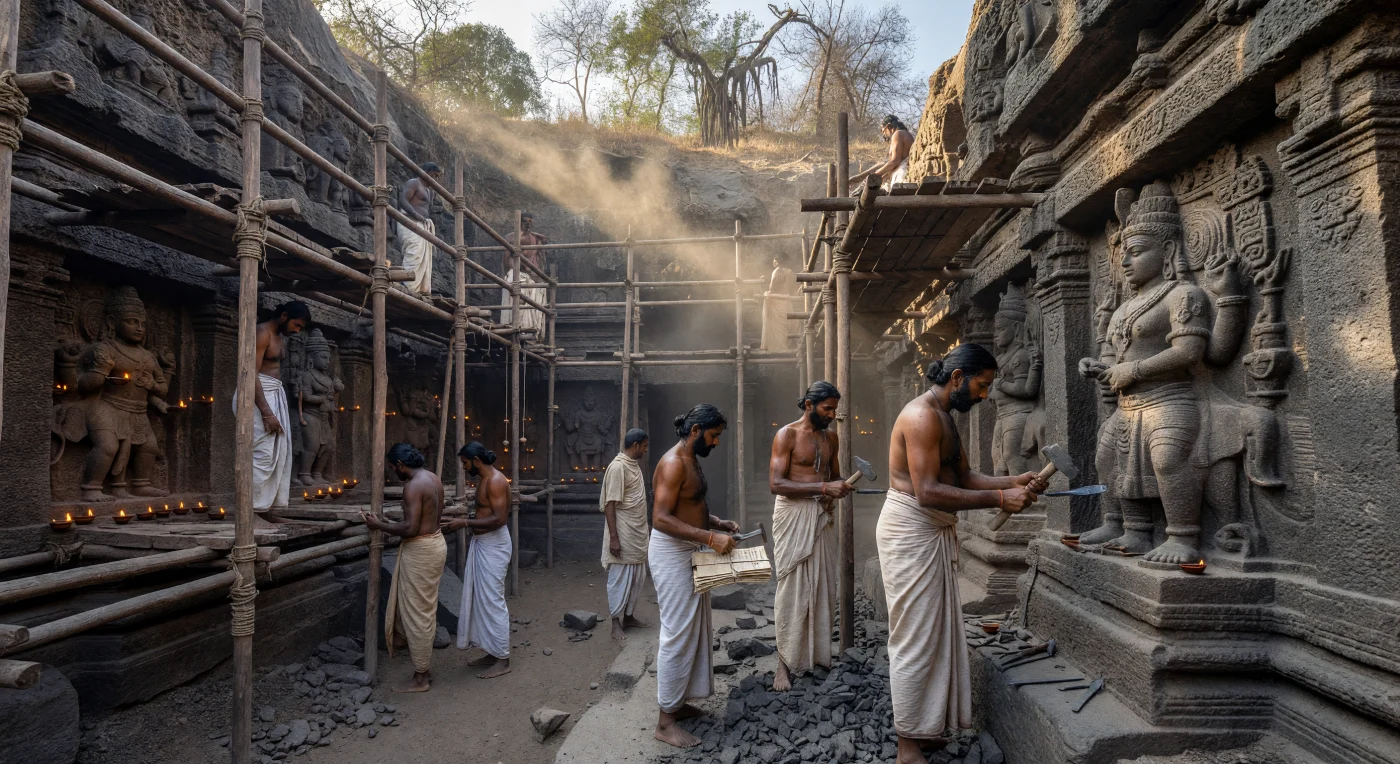
Artisans and stonemasons labor atop cedar scaffolding in the late 7th century to complete the Dome of the Rock, commissioned by the Umayyad Caliph Abd al-Malik. This scene illustrates the transition of Jerusalem’s skyline as workers apply intricate gold-leaf mosaics and Meleke limestone to the landmark octagonal structure, strictly utilizing geometric and floral motifs. The project represents a pivotal moment in architectural history, blending Byzantine craftsmanship with emerging Islamic aesthetics to create a monumental symbol of the Caliphate's religious and political authority.
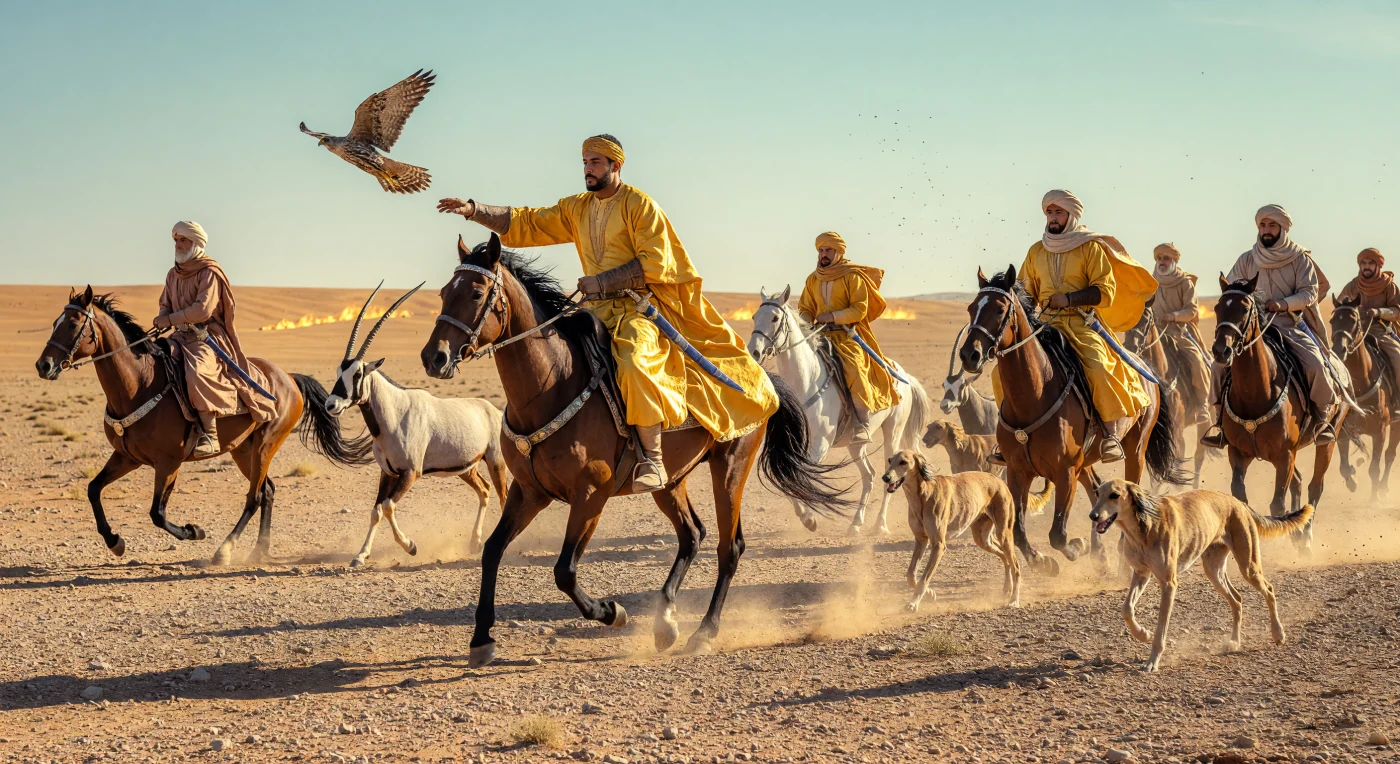
This scene depicts a 9th-century Abbasid noble engaged in the "tard," or desert hunt, a prestigious pastime that served as both a display of wealth and a demonstration of martial skill during the Islamic Golden Age. The hunter, dressed in a luxurious saffron-dyed silk kaftan, coordinates a sophisticated pursuit using a Saker falcon and feathered Saluki hounds to track an Arabian oryx across the arid gravel plains. Every element, from the straight-edged crucible steel sword to the refined Arabian horse, reflects the immense prosperity and the vast trade networks of a Caliphate that integrated cultures from Central Asia to the Mediterranean.

A traditional sewn dhow navigates the turquoise waters of the Persian Gulf, its teak hull meticulously bound with hand-stitched coconut-fiber twine rather than iron nails. Sailors of Arab and East African (Zanj) descent manage the heavy linen lateen sail and secure a cargo of oil held in characteristic blue-glazed Sasanian-Islamic jars. This scene illustrates the sophisticated maritime trade networks of the 9th-century Abbasid Caliphate, which served as a vital link in the "Silk Road of the Sea" connecting the Middle East with Africa and Asia.

This scene captures the vibrant commercial and intellectual life of 9th-century Baghdad, the capital of the Abbasid Caliphate and then the world’s leading center of trade and learning. Merchants of diverse Arab, Persian, and African descent negotiate over luxury silks and spices beneath intricate stucco arches, while a scholar carries a hemp-paper manuscript, a revolutionary technology that fueled the Islamic Golden Age. The presence of straight-bladed swords and sun-dried mud-brick architecture reflects the authentic material culture of the era, illustrating a cosmopolitan society at the height of its global influence.

A massive wooden noria water wheel dominates this 9th-century Mesopotamian riverbank, illustrating the sophisticated hydraulic engineering of the Abbasid Golden Age. These monumental wheels powered the Islamic Agricultural Revolution, lifting water into stone aqueducts to transform arid landscapes into lush "tri-level" gardens of date palms, citrus trees, and newly introduced crops like eggplant and spinach. In the foreground, an agricultural overseer consults a hemp paper manuscript, reflecting the era’s unique fusion of scientific administration, global botanical exchange, and advanced irrigation that sustained some of the medieval world's largest urban populations.

This scene depicts a wealthy family in 9th-century Baghdad during the Abbasid Golden Age, dining within the secluded tranquility of a traditional courtyard house. The architecture illustrates the era's sophistication through intricate stucco geometric patterns, cooling *mashrabiya* lattice-work, and early Kufic calligraphy. Surrounded by luxury goods like Persian carpets and scientific instruments like the astrolabe, this domestic setting highlights Baghdad's role as a preeminent global center of trade, culture, and intellectual advancement.

A column of Rashidun cavalry maneuvers through the rugged limestone hills of the 7th-century Levant, kicking up a thick veil of dust in the warm afternoon light. These Bedouin warriors are equipped with historically accurate straight, double-edged swords and round leather shields, reflecting the military gear used during the initial Islamic conquests. The scene illustrates the disciplined mobility of the Caliphate’s forces, who utilized both dromedary camels and Arabian horses to master the challenging terrain of the Syrian steppe.

This scene illustrates the arduous labor of 9th-century pearl divers along the Red Sea coast, a region vital to the maritime trade networks of the Abbasid Caliphate. Equipped only with polished tortoiseshell nose clips and hand-knotted hemp bags, these divers harvested *Pinctada radiata* oysters from the vibrant coral reefs to satisfy the global demand for luxury gems. The surrounding ecosystem, featuring grazing dugongs and dense *Avicennia marina* mangroves, reflects the pristine maritime environment of the Hijaz during the Early Middle Ages.